


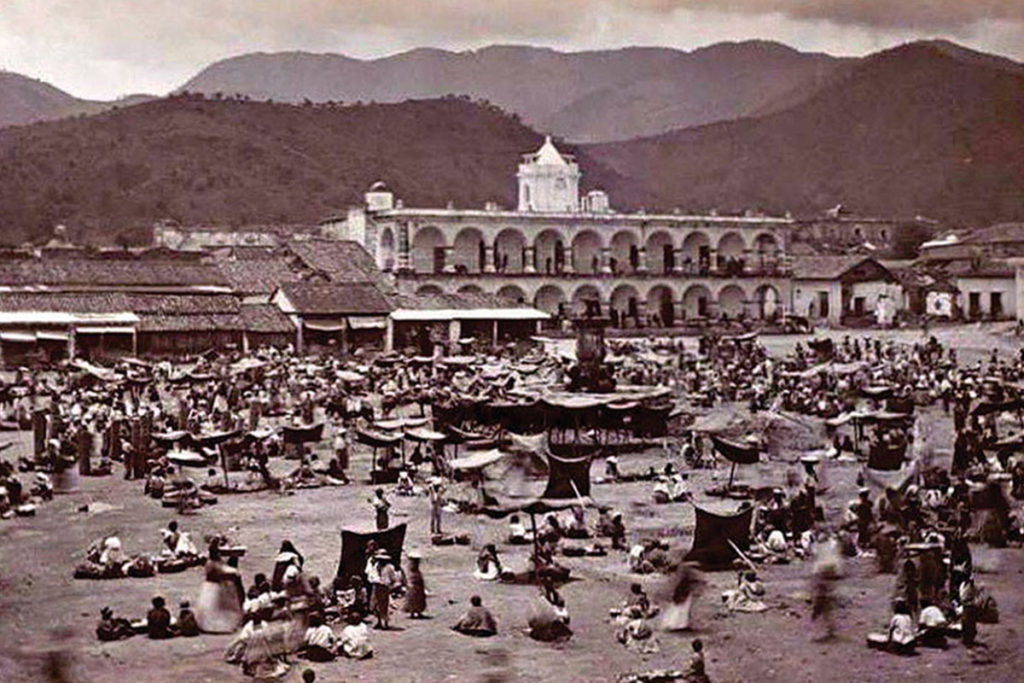
Central Park: The Beating Heart of Antigua
By Julissa Carrillo
There is a place where time seems to stand still, where the sounds, the flowers, the pathways, and the cobblestone streets feel preserved for memory; where the echo of history, the aroma of coffee, blooming jacarandas, and the murmur of people fill the air. Here, the past does not feel distant, but alive. This place is Central Park, and it continues to be the heart of Antigua Guatemala.
Our small city —though for those born here, it will always remain a small town—was founded in 1543 as Santiago de Los Caballeros de Guatemala. The layout of the city was designed by the Spanish Crown, which is why the central square served as the political, religious, and social nucleus. It is here that we find the representation of the three great powers: the Cathedral, the Palace of the Captains General, and the Portal de las Panaderas.
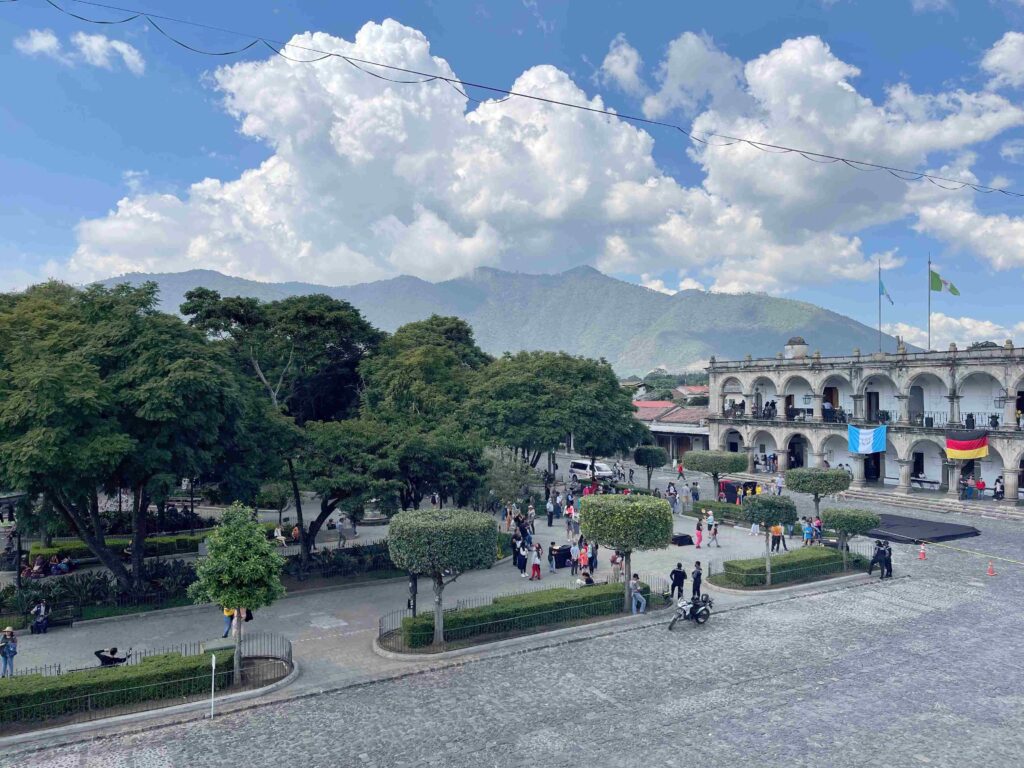
After the earthquakes that damaged the city, Antigua lost its status as the capital. However, it transformed into a city that preserved its history, which led to its designation as a UNESCO World Heritage Site.
Changes came to our small home, yet Central Park never ceased to be the beating heart of these cobblestone streets filled with dreams and history. Bringing people together beneath its trees, listening to Marimba music, and walking around the fountain adorned with mermaids.
These mystical mermaids have witnessed countless Holy Weeks, standing elegantly in the iconic Fountain of the Mermaids, from which water flows gently, its soft murmur accompanying generations.
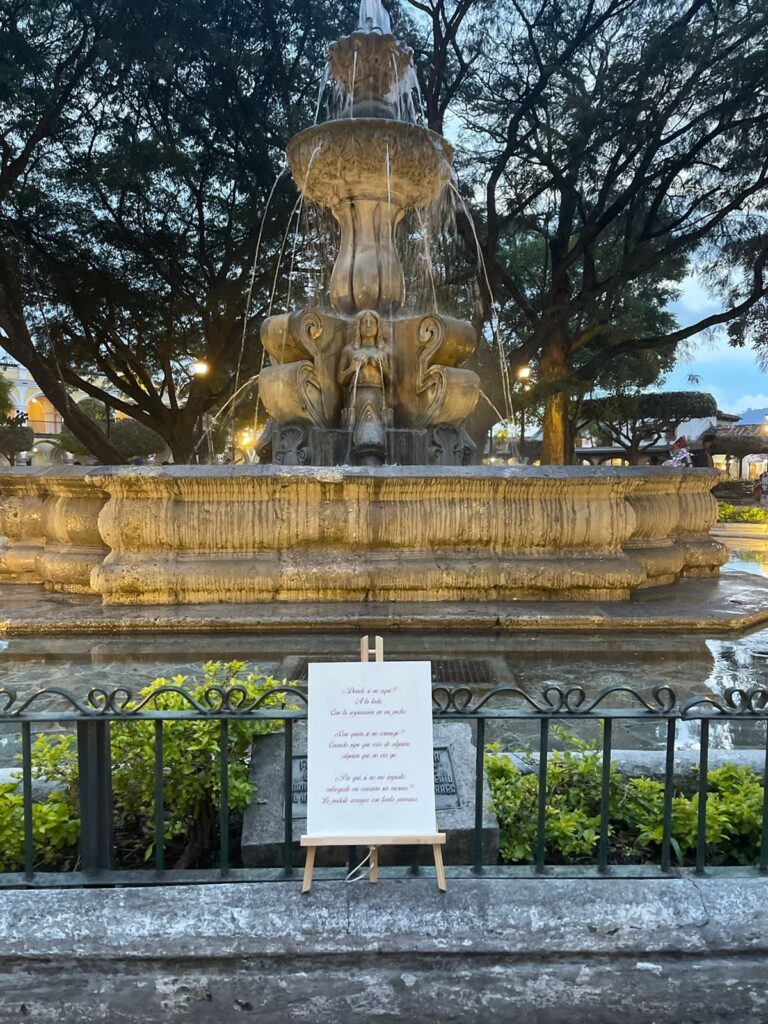
This is the center of everything. Life moves around these mermaids: pigeons rest and drink from the fountain, children run or ride their bicycles around it, couples hold hands in front of it, and photographers frame it with the Cathedral in the background. It has witnessed declarations of love, first dates, protests, laughter, tears, and moments of quiet reflection.
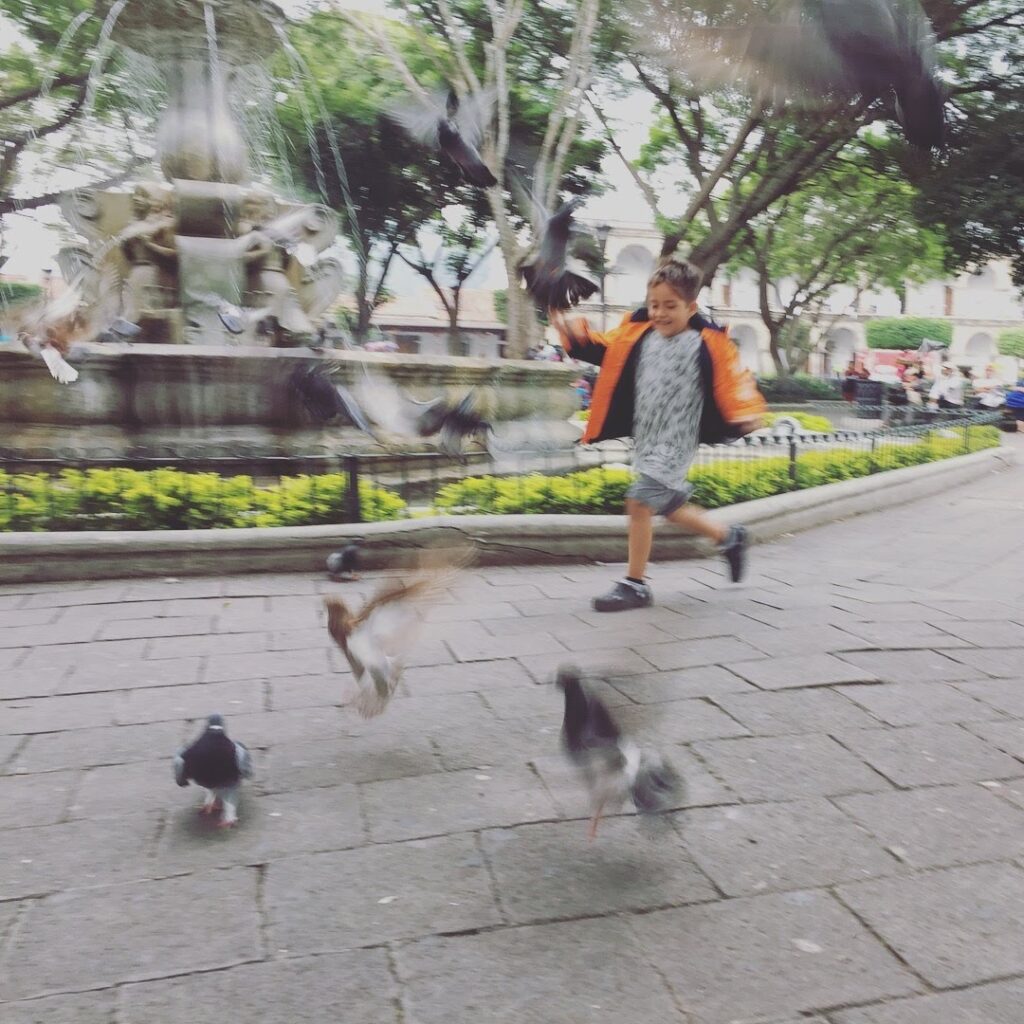
For the people of Antigua, the park is filled with memories. It is the place of Sunday afternoons after Mass, of family conversations, of childhood spent chasing pigeons. It is also the setting for traditions and national celebrations. For foreigners, the park is often their first encounter with Antigua, the place where the city reveals itself through its volcanoes, its architecture, and its unhurried rhythm.
Here, languages, stories, and gazes intersect. And although each person arrives for different reasons, they all share the same feeling: that of being in a special place.
To be in Central Park is to experience it with all the senses:
The Cathedral bells mark the passing of time. The music of the Marimba fills the air. Conversations, children’s laughter, and the flutter of pigeons create a constant background.
And among all this, there are the vendors.
They offer colorful textiles, handcrafted goods, woven bracelets, and small handmade souvenirs. Cotton candy rises in bright clusters. Soft voices call out, offering their goods. The air fills with aromas.
To sit on one of its benches is to become part of something greater: a continuity of life, memory, and beauty.
In Antigua, everything seems to lead back to this place.
And once you are here, you understand why.
Reflections on Central Park (Parque Central or Plaza Major)
Note from the publisher:
The following article is an interesting personal historical record of the park. Sadly, I don’t know who wrote it but it’s well worth a read.
It has been well known for a while that the Parque Central in Antigua has been in need of an urgent renovation. This attractive park needed to be organized and beautified; especially bearing in mind the grand manner in which it was constructed during one of several periods in which my Grandfather – Manuel Francisco Pellecer – was Mayor. He was the first to carry out a remodeling of the park – in part due to the celebration of the 1st Central American Congress of Municipalities held in Antigua in 1921.
But before that could happen – my Grandfather said – he had to clear the Plaza Central (as it was known in the colonial and post-colonial period) of rubble and debris left over from the earthquakes of previous years (1917-1918) that had devastated the city and the park.
It was my Grandfather who planted the Manzanote trees that circle the park. This type of tree grows abundantly and always appears green and fresh.
As far as I understand, it was during Francisco Saenz’s tenure as Mayor that the idea to trim the trees into animal shapes was proposed. By trimming them senselessly and without a clear idea of the outcome (rather, making them ridiculously rounded), the only thing that resulted from that idea was that many of the trees died, whilst others became sickly and a large part of the remaining ones served as a woeful representation of ruination and abandonment.
I would go so far as to say that who made the most effort to turn this Plaza Central into a pleasant space for public use was General Carlos Jurado – at that time the regional Political Chief (a job description that has now become known as ‘Governor’).
The Plaza was made up of beds planted with flowers in a fairly organized fashion and giant trees surrounding the old colonial pila, upon which was constructed a bandstand for music concerts. The pila by then was completely destroyed, in ruins and without water. Of course, it’s important to remember that perhaps its most famous moment was when it served as a platform upon which the well-known Antigueño ruffian ‘Chiquirin’ was shot.
So, General Jurado had three round concrete patios laid out in the middle of the garden that still exist to this day; and in the center circle (next to the bandstand) people would dance every night that concerts were held there – they would dance masterfully; men dancing together with men; all sorts of people from the working class (shoe shiners, bricklayers, carpenters…) who would tend to come from the villages and towns surrounding the city. It was an incredible spectacle to witness due to the amazing skill of the dancers.
General Jurado also had ornamental posts installed to support the electric lights in the form of luxurious white lanterns. He also built the small fountains in the four corners of the park with steps up to them protected by balustrades covered with vibrant hanging baskets of flowers.
Also in the heart of the garden Jurado had two ‘3D maps’ installed – one facing the Cathedral and the other in front of the Teatro Diaz (nowadays known as the ‘Portal de las Panaderas’. These maps didn’t depict any specific part of the country’s geography; although one seemed to represent the Valle del Panchoy (at least because of its volcanoes, because its valleys were full of clear water in which colored bream swam happily).
Opposite the Palacio de los Capitanes – halfway across – a statue proudly stood, holding a bust of Doctor Mariano Galvez: eminent Antigueño, ex-President of the country and a very forward-thinking man who’s only descendent at that time was the so-called ‘Niña’ Angelita Galvez.
The people of Antigua were very proud of that statue of Galvez, on the base of which you could see 3 scenes in bas-relief that showed certain military or parliamentary moments from Galvez’s presidency; whilst on the fourth side was depicted the story of the construction of the park, its author and patrons. This statue was later destroyed by some other Mayor or political adversary of Galvez in an act that deprived the younger generations of the opportunity to discover the history of one of the most important national heroes.
On the other side, (just like in every town across the country), a statue to General Justo Rufino Barrios was erected that – although horribly disproportionate – stayed in place for many years until the last remodeling of the park in the 90’s when it was finally taken down.
Marble statues of classic and mythological figures were also erected for a time, although these were later moved to other parks and some to La Candelaria – where nowadays they can be found completely abandoned, victims of the inclement weather and people’s ignorance of the historical and cultural value that they possess.
With the passing of the years, huge concrete benches were installed, the bandstand and the 3D maps were demolished and the old Fuente del Conde de la Gomera (the old fountain – also known as ‘La Fuente de las Sirenas’) was renovated based on the original remains that had been kept in the Museo Colonial below the Palacio del Ayuntamiento for several years.
It wasn’t until the administration of Hector Vides Casanova (1991-1996) that the park was truly remodeled – not just the backdrop but the form of the park itself – thanks to the efforts of the Honorable Corporacion Municipal and the Legion de Santiago de los Caballeros.
Now – 20 years later – people have just started thinking seriously again about remodeling the park once more and – thanks to the intervention of the current Corporacion Municipal and the private enterprise who have been tenaciously carrying out this task in a manner worthy of the greatest praise and commendation – it is happening.
Our park is a meeting point for locals and foreigners; it is an icon that represents us beyond our borders, it’s a place that at some point marked an important moment in our lives; the place that still holds the nostalgia of our childhood adventures….for these reasons it should be given a new life and brought back to its former glory as soon as possible. Congratulations to those responsible for this transformation.

